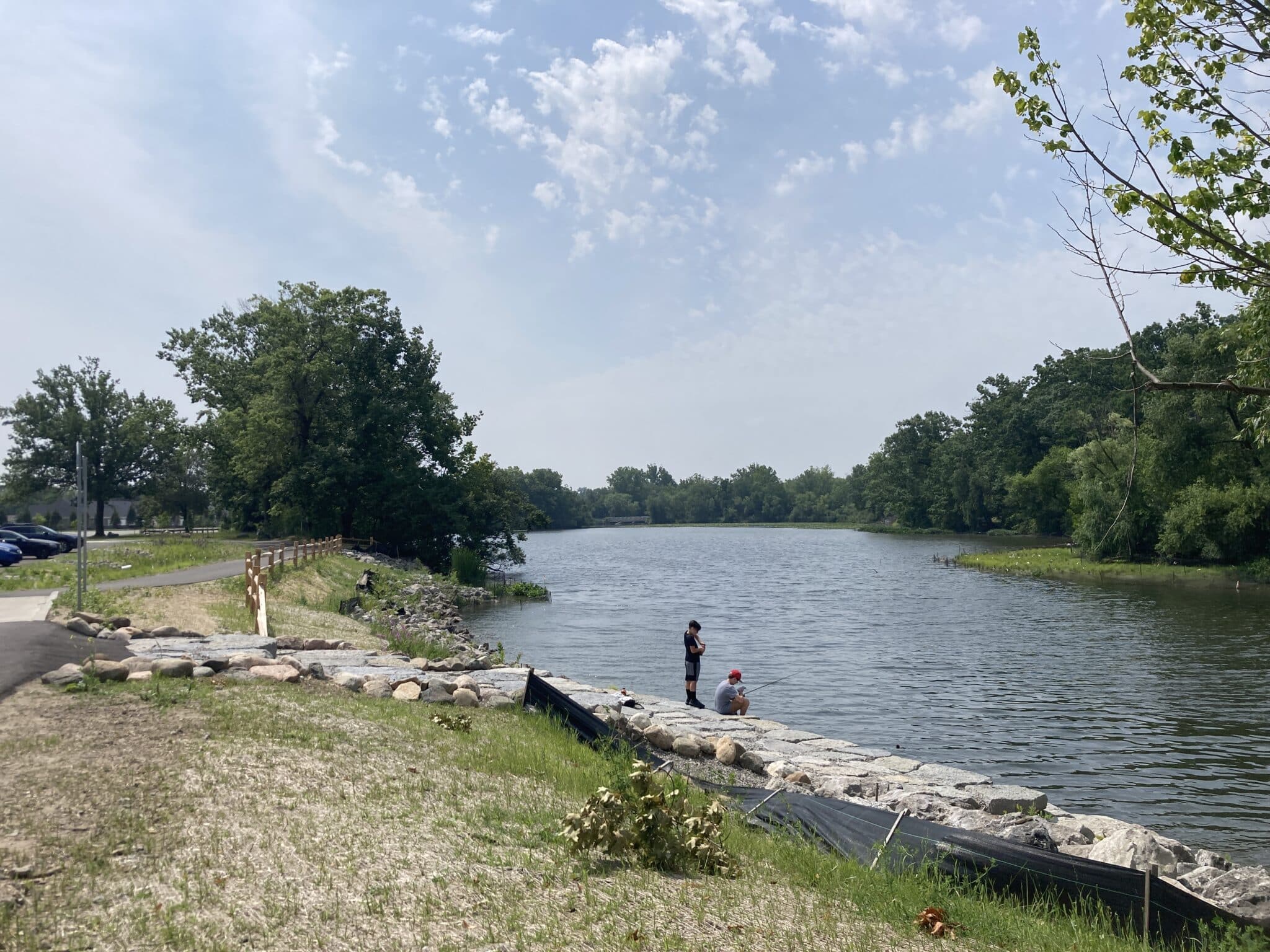
EPA Funded Project Restores Nankin Lake in Rouge River
Nankin Lake Habitat Restoration
Livonia, Michigan
Generations of sediment buildup caused significant problems for Nankin Lake, a small impoundment lake created by the Henry Ford dam on the Middle Branch of the Rouge River in Wayne County, Michigan. Over time, the sediment buildup decreased water acreage, degraded shallow water habitats, reduced fish productivity and carrying capacity. In addition, the impacted flow during storm events affected impoundment and downstream habitats. ECT was contracted to design and oversee implementation of the restoration of lake ecosystem functions of Nankin Lake. The improvements included restoration of valuable spawning, nursery, and cover habitat for fish and other aquatic species of all life stages.
In 2016, Wayne County received approximately $3.5 million from an Environmental Protection Agency (EPA) Great Lakes Restoration Initiative (GLRI) grant for the project as part of its effort to delist the Rouge River Area of Concern (AOC). ECT was hired to complete the data gathering, engineering and design, permitting, construction bidding and oversight, and grant administration support.
As part of the restoration efforts, sediment was removed and the reservoir basin was reshaped. This created more open water habitat, restored the shallow water habitat, and allowed more over-wintering deep water habitat. The completed restoration provides habitat for pike, yellow perch, salamanders, sunfish, black crappies, frogs, aquatic insects and more. Invasive vegetation management was conducted within the corridor, targeting species such as garlic mustard, buckthorn, and Siberian elm. Additionally, native vegetation was planted in shallow water areas and around the lake to create habitat and improve the overall water quality of the lake.
In total, the restoration activities provided the following ecological benefits:
Removed 35,000 yards of sediment from within the lake and reshaped the reservoir basin morphology to create more open water area, shallow water habitats, littoral zone aquatic bed wetlands, structured drop-offs, and over-wintering deep water habitat.
Sediment dewatering operations.
Diversified aquatic benthic substrates using sandy gravels, providing spawning substrate, attachment points, and cover for fishes, insects, crustaceans, as well as fauna.
Creation of new habitats with native submerged, emergent, and floating aquatic vegetation.
Increased habitat diversity with woody debris from felled trees placed offshore.
Added boulders offshore for spawning fish that require deeper water and then added cover as well as feeding areas.
Wayne County millage funds supported the addition of a bike rack, bike service station, kayak rack, kayak launch, and a dock.
Erosion bank stabilization with public access.
Implemented improvements to impervious surfaces to reduce direct non-point source pollution to the lake, including vegetative upland no-mow buffers and bioswales.